
Reciprocal Memory
Jan 14, 2026 | By Emma Ventresca BF ‘26
An old friend came to visit campus and brought his girlfriend along to visit Yale for the first time. He asked if I would give her a tour, and of course, I obliged. We started in Sterling Memorial Library first, the cathedral-turned-bohemoth library in the center of campus. While I walked through the front doors and beelined it to show her my favorite reading room, my friend and his girlfriend remained at the front entrance staring up at the ceiling. Then I realized—my tour of Yale was not a standard admissions tour. For me, the highlights of Yale were not its architectural wonders, but the people who inhabited them.
I cannot deny that Yale’s Gothic revival buildings are a sight to behold. But how we interact with architecture changes over the course of our collegiate careers. How quick we are to believe that our writing, our mathematical solving skills, or musicianship will be infused with some abstract spirit of the “Yale intellect” merely by our physical proximity to grand architecture and places where other scholars have achieved greatness. But oftentimes, we forget that the very student sitting across from us, challenging us, and exchanging ideas with us are the true source of wonder.
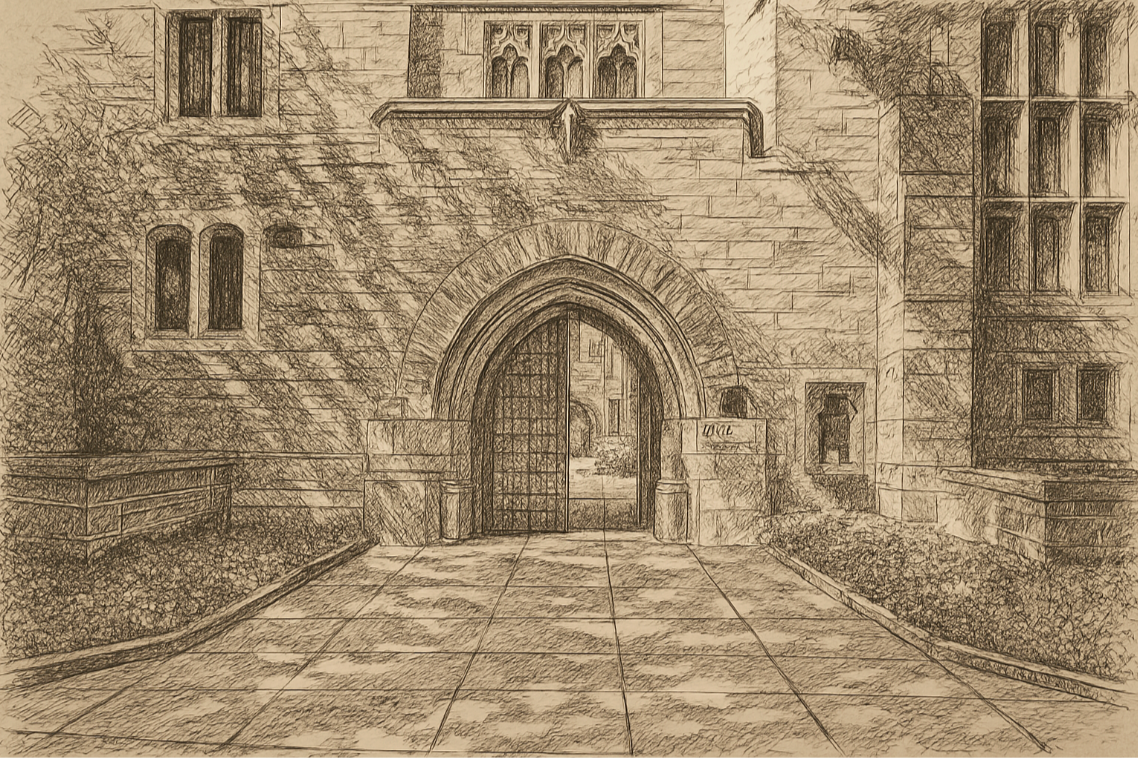
When we arrive on campus as first-years with light in our eyes, we take in the buildings in all their glory. We soak in the magnificence of Phelps Gate, imagining ourselves riding on a motorcycle through its archway like Harrison Ford or writing our next literary magnum opus deep into the night in the Classics Library. We see Old Campus in all its glory (exteriorly) and somehow find our freshman dorms to be horrible and homey at the same time. We take great pride in inviting others over to our residential college dining hall and sit ourselves in the middle of Starr Reading Room to “feel” like a Yale student. The architecture on campus becomes a wellspring of imagination, a source of inspiration, and perhaps the most defining aspect of our early days here.
If someone visited me on campus during my first year, I would have been most excited to show them the ceilings and the quads and the dining halls—all the important Yale things. But now, I’d rather show them places which paint a picture of the important people in my life—the places where others changed my mind, the places where I had fulfilling debates with a classmate, the places where meaning derives from those who inhabit the space rather than the space itself. My tour would not consist of the Starr Reading Room nor the Special Collections, but a spooky carrel on the seventh floor of the stacks where my sophomore friend group would study. Assuredly, the time I spent working on econometrics problem sets in the sterile Digital Humanities Lab with someone who is now one of my closest friends was more transformative than my glances at Sterling’s breathtaking facade.
Once the novelty has worn off a bit, we start seeing the people on campus more than the places. We start spending more time with friends in the Jonathan Edwards basement music room than we do in Starr, in our friends’ dining halls than in our own, in their messier suites than in our own well-appointed dorms.
What it means to “feel” like a Yale student at this point is far different from how we felt when we entered. At first, it meant sparring with the greatest intellectuals of one’s generation, engaging with new texts at every turn in hallowed halls. While this certainly remains true, being a Yale student also feels vulnerable. It feels messy.
Feeling like a Yale student becomes increasingly about feeling connected, placing ourselves in spaces for the sake of the people in them, even when we are stressed about finals or life in general. Of course, an “especially Yale” setting is always a plus, but sometimes the most forgotten rooms on campus—a dingy, sterile 17 Hillhouse classroom, even—engender the greatest feelings of nostalgia and contain some of our favorite memories.
The connection between space and memory has been extensively explored by philosophers, artists, psychologists, and architects alike. Philosopher Edward S. Casey describes how “body memory is [...] the natural center of any sensitive account of remembering. It is a privileged point of view from which other memorial points of view can be regarded and by which they can be illuminated [1].” Architect Donlyn Lyndon highlights how encounters with the physical world make distinct imprints on our corporeal natures, allowing us “to imagine, hold in the mind, and consider” a given space on a higher mental plane [2]. In Casey’s words, this phenomenon effectively transforms a “site” into “place” in the mind of an individual or collective that has interacted with it [3].
And thankfully, memory is not contingent on inhabiting an architecturally indulgent or deluxe space; Lyndon highlights how “Seeking to make each place a singular, memorable work of art often makes the insistence of its vocabulary resistant to the attachment of memories—to the full engagement of the people who use and live with the building” [4].
A room which does not dictate how the individual should interact with it aides rather than inhibits our capacity for memory and association. It is no wonder that even the most drab lecture halls or mundane study rooms can invoke an emotional response for us; our memories have been molded by our experiences in the spaces—shared struggles over problem sets and blossoming friendships—rather than the grandeur of the spaces themselves.
But this is a two-way street—spaces reciprocally imprint on us as well. Take the example of postmodern dancer and multimedia artist Jonathan González, who seeks to accomplish two goals when choreographing site-specific pieces: to draw on the memories living within a space and reimagine the meaning of the space itself in a modern context through movement. González’s most recent work Spectral Dances at New York City’s American Academy of Arts and Letters invites viewers to freely walk through rooms of the Academy and witness movers interact with a space once constructed for exclusivity [5].
The memories which witnesses make in the space and the memory which González’ experimental choreography imparts on the architecture clash with the institution’s history of exclusion and elitism. González uses this contrast as an opportunity to contribute a new perspective to the Academy’s history which will leave a legacy in the space. While a passerby may have once felt intimidated by the Academy’s high walls and vaulted ceilings, the memories that a viewer now associates with that space may be ones of welcome, curiosity, and artistry.
An even more palpable example of the idea that interacting with a space impacts its memory can be found in how González embedded the sounds of experimental music scores into the very foundations of the building. Visitors could feel his music pulsating throughout the support structures and murmuring behind walls of adjacent rooms [6]. With the examples of Casey, Lyndon, and González in mind, we can hardly say that the mind alone contains memory; interacting with a space not only forms strong neurological connections in the individual but also impacts the physical environment itself.
On Yale’s campus, it is typical for a tour group to stop and admire spaces that notable students, alumni, and guests have inhabited and effected over the years—Nathan Hale’s dorm, the Schwarzmann Center, the Sterling Memorial Library entryway. While these locations are certainly worth attention and commemoration, memory and meaning are not unique to them.
Perhaps a basement library study room can impact students’ memory of Yale more than a monolithic Gothic-revival bell tower can. Casey, Lyndon, and González show us that we need not sit in the Starr Reading Room to “feel” like a Yale student. Instead, maybe all we need is to surround ourselves with close friends, wherever they may be on campus. A stuffy dorm room, a nondescript bench outside, or even a coffee shop can take on special meaning over our bright college years. As long as we are able to inhabit the same spaces as those whom we treasure most, Yale will be a campus of people and “places,” not just “sites.”
[1] Casey, Edward S. Remembering: A Phenomenological Study. Indiana University Press, 2000.
[2], [3], [4] Treib, Marc. Spatial Recall: Memory in Architecture and Landscape. Routledge, 2009.
[5] González, Jonathan. Spectral Dances. Performed in the American Academy of Arts and Letters, 5-27 Oct. 2024.
[6] González, Jonathan. Ways to Move: Embodied Research, Choreographic Inquiry, and Performance as Method. Yale University. 11 Nov. 2025. New Haven, CT.