
Friendship as a Fruit of the Spirit
Jan 14, 2026 | By Colin Levine SY ‘28
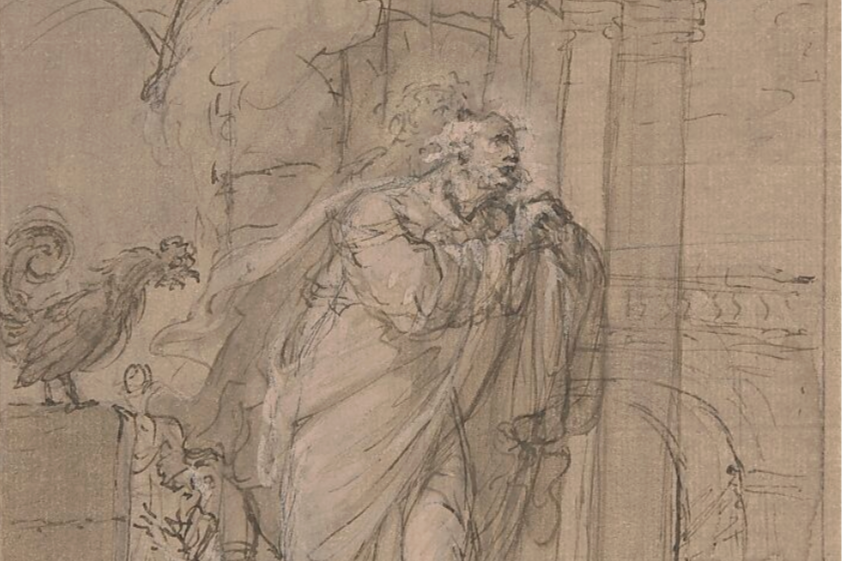
At first, Peter runs away, racked with fear. But then he turns and tentatively follows his suffering friend from a distance. Peter wants to be with his friend in the end: a feat he believes he has the moral strength to achieve. He proudly promised his friend only a few hours ago, “Even if I must die with you, I will not deny you!” And so he sits just outside the trial proceedings, watching, and warming his hands with the masses on the cold April night. Then Peter’s resolve is put to the test: a servant girl approaches and accuses him, saying, “You also are one of this man's disciples, aren’t you?” Peter, lest he should actually die with Jesus, denies him, assuring the girl, “I am not.” A second girl recognizes Peter and declares, “This man was with Jesus of Nazareth.” This time, Peter swears an oath, denying any relationship with his best friend: “I do not know the man.” Finally, a third bystander approaches and offers Peter a final chance to honor his promise, accusing him, “Certainly you too are one of them.” And Peter, once again, invokes curses and oaths to make sure he escapes any association with his greatest friend, who just hours ago washed his feet and years ago called him to eternal life. Peter swears, “I do not know the man.”
A rooster crows. Peter runs out of the courtyard, weeping. He realizes his sin. He remembers what Jesus told him when he made his false promise: “Before the rooster crows, you will deny me three times.” He also realizes just what his failure means, for in the same meal, Jesus taught him, “Greater love has no one than this, that someone lay down his life for his friends.” Peter lacks this love. He knew that such was the love proper to his friendship with Jesus, so he promised Jesus that he would die for him.
But such love did not dwell in Peter. So he failed, and so he now mourns. He doesn’t end up being there for Jesus in the end. He doesn’t see to it that Jesus is buried. He goes and hides, for fear he should be known as Jesus’ friend and have to follow through on his false promise. It’s just too great a sacrifice [1].
We’ve all had friends like Peter. We’ve often been that friend to others. Such a friend tells you he loves you, that he would go to the ends of the earth with you, maybe even die for you. But then the chance to follow through actually comes to pass.
In one case, the rest of the friend group starts to think you’re not “cool,” and they stop inviting you to hangouts. Your friend, lest he should have to suffer with you, goes along with them and laughs at their jokes about you. He can’t stand up to them and face rejection for your sake. That’d be too great a sacrifice. So he denies you.
In a second case, a dear relative passes away, and you’re devastated. Trusting he will want nothing but to be there for you, you lean on your friend. You can’t sleep at night because all you can think about is your loss, so you ask your friend to stay up and comfort you. He eagerly accepts the first night. The second night, you think you notice a hint of exasperation in his tone, but you trust it’s nothing. So, a few nights later, you text him again as you struggle to rest your mind. This time, he doesn’t respond. You lay there with your grief, crying softly. The next day, he texts back that he had a test in the morning, so he couldn’t help. It was just so important that he ace the test, and that meant getting a good night's sleep. He can’t be expected to put you above his grades – that’s too great a sacrifice. So he’s denied you again.
In a third case, you and your friend apply for the same internship. He has several other options, but they’re a little less prestigious. As for you, this opening is your last shot at a summer job, and you tell him that. “What… am I expected to take a career hit for you?” he responds. He wins the job over you. He excitedly sends you his new salary, with a note: “No hard feelings – you just can’t ask so much of a friend.” So he’s denied you a third time.
A rooster crows. Really, your heart breaks. You realize there’s only so much you can ask of a friend in the great big rat race of life in this world. Some sacrifices are just too much. You can’t expect a friend to put you above himself, or even to love you as himself. Once realized, this reality comes with perpetual insecurity and anxiety as you navigate the invisible but impregnable bounds of friendship in this world: what can I expect of him, and when will he abandon me?
Now consider Peter after the indwelling of the Spirit. By the grace of his divine perfection, Our Lord was not crippled by friendship-angst as we are. Rather, forthwith after his resurrection, Jesus returned to Peter and gave him a second chance at true friendship. He met the disciples where they were at, both spiritually and literally, hiding from the Jews in an attic. Jesus greeted them, saying, “Peace be with you.” And Peter was glad: his chance at friendship with his Lord and Savior was not lost. But Our Lord does not just meet us where we’re at: he takes us thence to where we should be. Indeed, on that night, Jesus fulfilled a promise he had made just hours before Peter denied him, a promise foreshadowing Peter’s very failure: “The Spirit of truth will be in you… If I go, I will send the [Spirit] to you [2].”
Paul would later write, “God’s love has been poured out into our hearts through the Holy Spirit [3].” John would similarly write, “If we love one another, God lives in us.” And what does it mean for God to live in us? John answers: “He has given us of his Spirit [4].” When Peter denied Jesus thrice, Jesus had not yet gone, so the Lord had not yet sent the Holy Spirit into Peter. God did not live in him, so he could not yet truly love and fulfill his friendly promises to Jesus.
But on the night of his resurrection, Jesus fulfilled his promise, breathing on Peter and his brothers and saying, “Receive the Holy Spirit.” Theologians dispute whether Peter and the other disciples first received the Holy Spirit upon that word or seven weeks later at Pentecost. But at some point in those first fifty days of the new age, we know that Jesus did fulfill his word, and his gift of the Holy Spirit changed everything. Meeting Peter amidst those fifty days by the Galilee, Jesus confirmed how the Holy Spirit would change Peter’s capacity for true friendship. Jesus asked Peter three times, “Do you love me?” Three times, Peter insisted on his love. Knowing Peter’s word was true this time, Jesus prophesied, “When you were young, you used to dress yourself and walk wherever you wanted, but when you are old, you will stretch out your hands, and another will dress you and carry you where you do not want to go.” While this prophecy may appear ambiguous, John tells us its meaning: “This he said to show by what kind of death he was to glorify God [5].” Peter would soon be offered a second opportunity to realize his promise to die for the Lord rather than forsake him, and this time he would not fall short.
Early Church sources attest well to the circumstances of Peter’s death. Just three decades after Peter’s death, Pope Saint Clement told us that Peter “was persecuted and fought to the death… [He] endured not one or two but many trials, and thus having given his testimony went to his appointed place of glory [6].” In the early third century, Tertullian wrote that Peter “endured a passion like the Lord’s” and that he was “girt by another, when he [was] made fast to the cross,” recalling Christ’s prophecy [7].”
Though apocryphal, the second-century Acts of Peter offers beautiful detail on how Peter may have honored his friendship with Christ. The author of the Acts tells us that when Peter fled Rome in the face of persecution, he had a vision of the Lord passing by the other direction, toward the city. Perhaps reminding Peter of his past failure, this vision convinced him to turn back. The Acts tells us, “[Peter] returned to Rome, rejoicing, and glorifying the Lord, for he said: I am being crucified [8].” Indwelt by the Holy Spirit, Peter rejoiced and glorified Jesus for the chance to finally fulfill his promise, to make the ultimate sacrifice for the friend he loved with a love than which no man has greater.
Such is the love and friendship promised by the indwelling of the Holy Spirit. Such is the love and friendship into which Christ invites you with open arms. Born of the water and the Spirit, there is no more angst in friendship. No more limit to self-sacrifice. Not three denials, not one. In Ephesians, Paul writes of a “dividing wall of hostility” before Christ’s sacrifice, engendered by sin. This dividing wall causes those of this world to compete with and ultimately deny one another for social and material standing. But “in himself,” Paul writes, Christ “makes one new man in place of the two, so making peace.” Only through the cross and consequent reconciliation to God do we become one body, “thereby killing the hostility [9].” Once the hostility is killed through Christ, “we, though many, are one body in Christ, and individually members one of another [10].” How are we one body? By one Spirit [11]. As one body, therefore, Paul writes, “If one member suffers, all suffer together,” as though every Christian brother is a second self [12]. Just as he would not suffer himself to be ostracized or to cry alone at night, a Christian brother is commanded to ensure you do not so suffer. He would not deny himself, so neither will he deny you. Thus, Scripture teaches, the transformation we see in Peter by the indwelling of the Holy Spirit is promised to every Christian. As Paul writes, by faith we are transformed into the image of the Lord as was Peter, “for this comes from the Lord who is the Spirit [13].”
In the Summa, St. Thomas explains how the Holy Spirit makes us capable of true friendship, for him concomitant with charity, the godly kind of love. St. Thomas writes that friendship and charity are fundamentally “the friendship of man for God.” Consequently, truly selfless, self-giving friendship is but two men loving one another “for God’s sake,” seeing His image in the other. So, St. Thomas suggests, one only grows capable of fully self-sacrificial love and friendship when one first so loves God. It is the Holy Spirit who works such charity in our hearts to enable godly friendships [14]. St. Augustine similarly wrote, when mourning the loss of an intimate friend from his pre-Christian life, “But he was not then my friend… as true friendship is; for true it is not but in such as You bind together, cleaving unto You by that love which is shed abroad in our hearts by the Holy Spirit [15].” For St. Augustine, true friendship could not exist outside the body of Christ, for it was impossible without the work of the Holy Spirit, who sheds love in our hearts and thus binds them together in Christ.
So we saw in the example of Peter. And so I saw myself. A convert myself only three years ago, I recall how different friendship was without the love of the Spirit binding two as though one. Friendship without a God to run towards together – continuous banter about sports, homework, and love lives – it was so empty. The underlying but pervading fact that we were ultimately engaged in a grand game, in which each would choose his own well-being if it really came down to it. And then the Spirit came over me, and I went to a fellowship night. And there was that Spirit of Love shed abroad in their hearts, radiating in their smiles and their genuine curiosity in even the smallest of small talk. There, intimacy was immediate, and we mourned and celebrated our greatest hardships and joys without any reason for this nascent love but that God in our midst, that God in whose body we were unified. There, love was patient and kind. Love bore all things, believed all things, hoped all things, and endured all things [16]. No more competition, no more angst, no more denial. For there, love transformed us into the image of Our Lord who promised, “Whoever comes to me I will never cast out [17].”
[1] Adapted from Matt 26, Mark 14, Luke 22, and John 18.
[2] John 14:16-17; John 16:7
[3] Rom. 5:5.
[4] 1 John 4:12-13.
[5] Unless otherwise cited, the events heretofore in this section are adapted from John 20-21.
[6] Pope Clement. Hoole, Charles. First Clement 5.2-4. 1885.
[7] Tertullian. Greenslade, S.L. The Prescription against Heretics and Scorpiace. pg 19-64. Library of Christian Classics. 1956.
[8] Callon, Callie . "Acts of Peter". Pg 35.
[9] Eph. 2:14-16.
[10] Rom. 12:5.
[11] 1 Cor. 12:13.
[12] 1 Cor. 12:26.
[13] 2 Cor. 3:18.
[14] Aquinas, Thomas. Summa Theologicae. IIa IIae 23.1-2.
[15] Augustine of Hippo. The Confessions of Saint Augustine.
[16] 1 Cor. 13:4-7.
[17] John 6:37.