
Thrown Into the Wilderness
Mar 9, 2026 | By Jack Batten BF ‘27
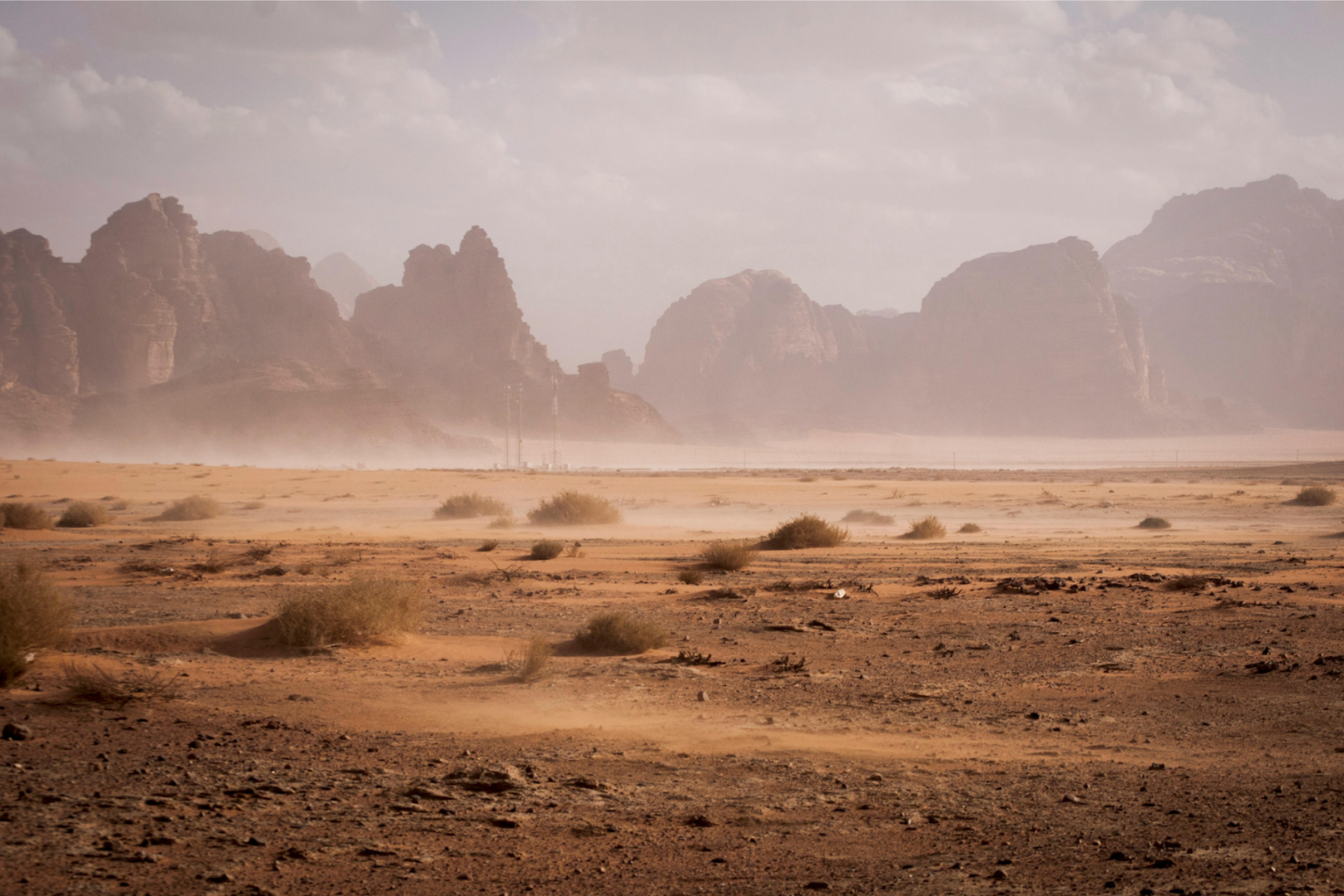
The Spirit immediately drove him out into the wilderness. And he was in the wilderness forty days, being tempted by Satan. And he was with the wild beasts, and the angels were ministering to him. (Mark 1:12-13)
Mark’s account of the temptation of Jesus is the shortest of the three accounts given by the Synoptic Gospels. It lacks Matthew and Luke’s extended descriptions of Jesus’ dramatic dialogue with the devil, with their rapid shifts in location and high stakes. Instead, we get enigmatic mentions of wild beasts and angels, details that have puzzled commentators for centuries. Moreover, there is no quotation of the Old Testament and no explicit triumph of Jesus over Satan.
What to make of these differences? Perhaps a closer look into Mark’s language will provide some answers.
The great New Testament scholar R. T. France comments that Jesus’ temptation “is described in ‘static’ terms: he ‘was’ (ἦν) in the wilderness being tempted, and he ‘was’ (ἦν) with the wild animals.” [6] Meanwhile, grammatical agency rests with other actors: the Spirit, Satan, and the angels. Mark uses this language to describe a cosmic struggle between the Spirit and the angels on one hand and Satan and the wild beasts on the other, showing the supernatural realities behind Jesus’ ministry.
It seems Mark wants to emphasize that Jesus is never alone in the wilderness. The Spirit and the angels are there alongside him, but so are Satan and the wild beasts, a cast of characters fuller and more varied than that of the other synoptics. For Mark, the central conflict of this story is not Jesus vs. Satan but the Spirit vs. Satan. Jesus simply remains steadfast as invisible supernatural forces fight the battle for his soul. Mark’s main focus is not on temptation but on the supernatural conflict surrounding Jesus’ ministry.
A similar reality applies to you and me. We are never alone in the wilderness. This reality is both comforting and threatening. The Spirit is there with us, but so is Satan. A host of angels ministers to us, but the wild beasts prowl in the dark. These forces fight a battle for our souls even when our lives seem bereft of meaning, and we feel unimportant and ignored. Though the Lenten season may feel like a sojourn in a barren wasteland, Mark’s narrative is a reminder that the believer’s everyday life is the site of a spiritual struggle far more important than any military or political struggle in human history. Mark’s account emphasizes the spiritual battle around and through the believer rather than the conflict within us. Just like Jesus was a vessel for the Spirit’s struggle against Satan, so too the believer is the battleground where God pushes back the Devil’s control of the world.
The idea that we are not alone even in the most barren desert lingers on the fringes of Western culture. Stephen Sondheim captures this simultaneously haunting and reassuring feeling in his song “No One Is Alone,” from the 1986 musical Into the Woods. The song’s tone is deeply ambivalent, alternating between soothing promises that “you are not alone” and warnings that “someone is on our side; someone else is not.” “No one acts alone,” says the Baker, “careful! No one is alone.” Mark’s desert, like Sondheim’s woods, is a place where unseen spiritual forces test the believer. Like Christ in the wilderness, we must be on guard for the traps that Satan has laid while remaining confident in the Spirit’s aid. We must keep a weather eye out for the wild beasts that stalk the sands, while taking comfort in the ministry of God’s angels.
Mark’s depiction of the spiritual struggle outside Christ certainly accounts for some of his narrative’s unique qualities, but what to make of his odd silence regarding Christ’s internal spiritual struggle? After all, this is the story of the temptation of Christ, and temptation is something that happens within the soul. Another close look at Mark’s language is illustrative of this point. The verb in verse 12 translated “drove out” by the ESV is ἐκβάλλω (ekballō), and it literally means “to throw out.” The word is used elsewhere in Greek literature to refer to banishment [2], vomiting [3], getting your teeth knocked out [4], being thrown overboard [5], and cutting down trees [6], among many other uses referring to sudden and forcible action. Mark uses the same word later in chapter 1 (1:34) to describe Jesus casting out demons. A strange word to use of the Holy Spirit acting upon Christ!
The strangeness of this word choice is compounded by Mark’s decision to place the temptation narrative directly after Jesus’ baptism by the Spirit. In verse 11, the Spirit is descending on Jesus like a dove; in verse 12, the Spirit is throwing Jesus into the wilderness like Drake Maye might throw a football. The contrast could not be stronger.
By employing this vocabulary, Mark wants to emphasize the highs and lows of the spiritual life. The Spirit casts Jesus from a river to a wilderness, from community to loneliness, from an incredible spiritual high to a deep spiritual low. This abrupt shift from triumph to tribulation was a theme in the spiritual life of Christ, and it is also a theme in the spiritual life of every believer. After the baptism comes the temptation. After the victory comes the defeat.
So, prepare yourself for the desert while you still walk alongside the river. So often we wait to seek God until he feels far away from us, or until we encounter hardships and suffering. Yet Isaiah calls us to “seek the Lord while he may be found, call upon him while he is near!” [7] Mark’s account of Jesus’ baptism and temptation reminds us that times of prosperity and spiritual rejuvenation are best spent preparing for the wilderness season that is bound to follow.
In the first of his Ninety-Five Theses, Martin Luther says that “the entire Christian life is to be a life of repentance.” The whole Christian life is falling down and getting up again, running away and returning home. Jesus knows that you and I will fall for the devil’s desert deceptions over and over; otherwise, he would not have become man and gone through the desert in our place. Commentators see rich references to the Old Testament in these short verses: Christ is a better Adam as he tames the wild beasts (Gen. 1:26-31); Christ is a perfect Israel as he recapitulates the exodus (Deut. 6-8); Christ is a better Nebuchadnezzar as he assumes kingship while wandering in the wilderness with wild beasts and angelic attendants (Dan. 4:28-37). [8]
Christ has persevered where you and I have fallen away, succeeded where we have failed! Let his victory be your own this Lenten season.
[1] R. T. France, The Gospel of Mark: A Commentary on the Greek Text, New International Greek Testament Commentary (Grand Rapids, MI; Carlisle: W.B. Eerdmans; Paternoster Press, 2002), 83.
[2] Thucydides, History of the Peloponnesian War 1.126.12; Euripides, Medea 373.
[3] Sophocles, Antigone 1238.
[4] Euripides, Cyclops 644.
[5] Homer, Odyssey 15.481
[6] Homer, Odyssey 5.244.
[7] Isaiah 55:6.
[8] Ben Witherington III, The Gospel of Mark: A Socio-Rhetorical Commentary (Grand Rapids, MI: Wm. B. Eerdmans Publishing Co., 2001), 77.