
The Hidden Literary Design of the Bible
Oct 13, 2026 | By Sydney Iravanchy - UCLA
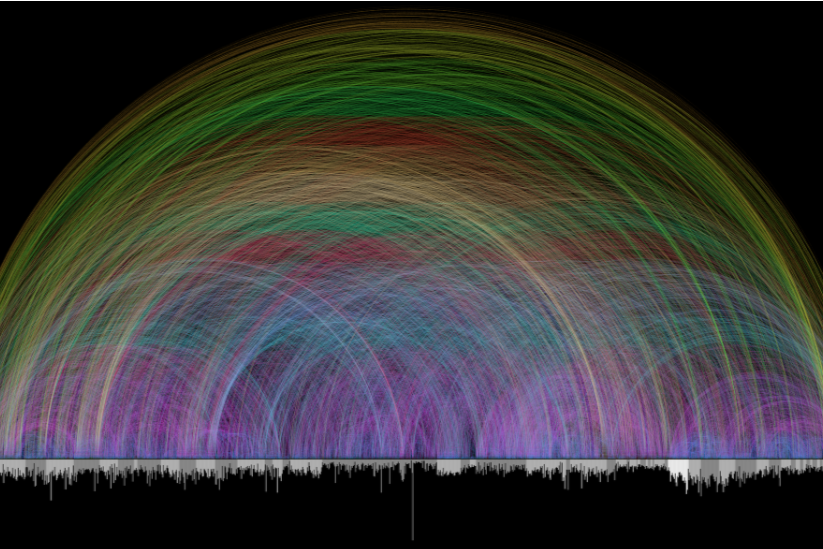
Many literary components shape the Bible, just as they do any piece of literature. Its collection of divinely inspired books is a mix of narrative, poetry, and parables. One literary component, however, can only be seen once the reader takes a step back, viewing the text as a whole. The thumbnail picture for this article is a visual representation of all 63,779 cross-references found in the Bible. Chris Harrison describes cross-references as “conceptual links between verses, connecting locations, people, phrases, etc. found in different parts of the Bible.” In collaboration with Pastor Christoph Römhild, Chris Harrison created this visualization, wanting to highlight both the complexity and beauty of the Bible.
Examples of cross-referencing emerge all over the Biblical accounts, particularly in the Gospels. For example, when John the Baptist says, “Behold the Lamb of God, which taketh away the sin of the world…” he is referencing the earlier Isaiah 53:7, “he is brought as a lamb to the slaughter.” In Isaiah 53:7, Isaiah tells a story of a suffering servant, using a simile that prefigures Jesus’s future suffering, who was often referred to as the Lamb. In describing Jesus as the Lamb, John connects Him to Isaiah’s prophecy, as Jesus would later be sacrificed to take away the sin of the world. The verse in John not only cross-references Isaiah, but also expands on and fulfills Isaiah’s prophecy. So what is the significance of all of the cross-references found in the Bible?
The first suggestion that the 63,779 cross-references point to is a divine authority behind the Bible. Historians and scholars agree there were many authors of the Bible, on different continents, in Hebrew, Aramaic, and Greek, and written and compiled over approximately 1,500 years. Unlike today, access to communication with people across different cities, let alone different countries and centuries, proved very limited. Thus, each cross-reference begs the question, “How did these authors maintain such remarkable continuity?” The divine authority argument suggests that a higher power is leading the reader closer to the central focus of the Bible: Jesus.
In the example from the verses above in Isaiah and John, John leads readers to see the bigger picture of what Isaiah was alluding to in his story of the suffering servant. John illustrates Jesus as their sacrificial Lamb, replacing Old Testament practices of offerings, paying the price for all of their sins. This continuity of the Bible’s central focus on Jesus suggests a higher power behind the literary work we witness today. Today, we are able to recognize the impossible ability for man, let alone forty men, to craft or even come close to the literary genius of the Bible.
The popular billion-dollar franchise, Harry Potter, written by J.K. Rowling, showcases the natural human inaccuracies that occur when designing a layered story. Over the years, fans have pointed out plot holes, some of which have the possibility of altering the entire narrative. The Marauder’s Map, a map of Hogwarts that shows every character's whereabouts, is used by Harry Potter to find Peter Pettigrew. However, its previous owners, Fred and George Weasley, seem to have missed this crucial piece of information despite frequently using the map. This small detail might seem harmless, yet the plotline of the third book, and the rest of the series, would pan out very differently without it.
In comparison, despite having fifty-eight more books than the Harry Potter series, the Bible has yet to contain any contradicting or inaccurate information that would seriously alter its overarching narrative. Therefore, it seems plausible to conclude that it could not have been man, but God, who gave man the words to write the Bible, weaving in literary elements to point towards its heavenly creator.
After all of this discussion about various genres, literary devices, and multiple authors, many non-English majors may be asking themselves, “What does the Bible’s literary design have to do with me?” The second suggestion that the cross-references in the Bible showcase is God’s overarching redemptive plan for humanity. From the very beginning in Genesis, God knew humanity needed a redeemer for their sins, one who would overcome sin and crush it underfoot (Gen 3:15). As early as the first book of the Bible, Abraham says to his son Isaac in Genesis 22:8, “My son, God will provide himself a lamb for a burnt offering: so they went both of them together.” This joins our earlier web, cross-referencing the lamb. God already had a plan to restore the brokenness that would soon follow, sprinkling it throughout the Biblical books. A key verse in God’s redemptive plan is highlighted in the widely known John 3:16, “For God so loved the world, that he gave his only begotten Son, that whosoever believeth in him should not perish, but have everlasting life.” Despite humanity's shortcomings and sin, God offers us the chance to be forgiven and to be made holy, just like the many redemptive stories in the Bible.
One particular story in the Bible perfectly captures God’s redemptive plan in each of our lives. In this story, a young Moabite widow named Ruth leaves her homeland with her mother-in-law Naomi to Bethlehem. Without their husbands, Naomi and Ruth have no provider and are in poverty, desperately needing help. Ruth then meets Boaz, a kinsman redeemer, who not only preserves her late husband’s name but also the land. This union saves both Ruth and Naomi from their situations and also establishes the lineage that eventually leads to Jesus Christ.
Just as God provided for Ruth and Naomi, God has a redeeming plan for us all. Through the constant reminders scattered throughout the Bible, the cross-references serve more of a purpose than just being a literary marvel. From the Old Testament to the New Testament, each cross-reference highlights the bigger picture and comforting promise of God’s plan to restore humanity. We can rest assured that God has a purposeful and redeeming plan for our lives, and all we have to do is trust and believe in him. The beauty of the Bible is not only found in the 63,779 cross-references woven throughout its pages, but also in the promises and truths that give peace, hope, and joy to whoever reads God’s words.
Chris Harrison, “Bible Cross-References,” BibleViz
All scripture verses were acquired using the King James Version.